
A VPN Is a Transport-Layer Tool, Not an Invisibility Cloak
Every VPN ad follows the same script. Hooded figure. Laptop. A red line sweeping across a globe. Somewhere on screen: browse anonymously — nobody can see what you do.
I want to take that claim apart properly. Not to tell you VPNs are useless — they aren't, and I'll get to where they earn their place — but because the gap between what the protocol does and what the marketing implies is wide enough to make people worse off. Someone who believes they're anonymous behaves like someone who is anonymous. That's the actual danger.
So let's start on the wire and work upward.
What actually happens when you connect
You install a client. It establishes an encrypted tunnel — WireGuard or OpenVPN, in practice — between your device and a server operated by the VPN provider. Your packets are encapsulated, shipped to that server, unwrapped, and forwarded to their real destination with the server's IP as the source address. Responses come back the same way.
Two things follow from this, and they're both real:
- Your ISP sees an encrypted flow to one endpoint. It no longer sees the individual destinations behind it.
- The destination site sees the VPN server's address, not yours.
That's the whole mechanism. It's transport-layer encapsulation and address substitution. Everything else you've been told about VPNs is either a consequence of those two facts, or it's marketing.
What your ISP could actually see in the first place
Here's where most VPN discussions — including a lot of the critical ones — get sloppy in the other direction. You'll hear that HTTPS already protects you, so your ISP "only sees metadata anyway." That understates what leaks.
Roughly 88–95% of web traffic is now encrypted, and TLS 1.3 encrypts most of the handshake including the server certificate. Your ISP genuinely cannot read your page content, your messages, or your credentials. But three channels still expose where you're going:
SNI. Server Name Indication carries the hostname in cleartext inside the ClientHello, before the encrypted session is established. The IETF's own ECH specification calls it perhaps the most sensitive unencrypted information remaining in TLS 1.3. It exists for a mundane reason — the server needs to know which certificate to present when many sites share an IP — but the side effect is that an on-path observer reads the domain you're requesting. Encrypted Client Hello (RFC 9858, finalised late 2024) fixes this by encrypting the inner ClientHello, but deployment is still partial and depends on the site publishing the right DNS record.
DNS. Classic DNS is plaintext and unauthenticated. Every hostname lookup your device makes travels in the clear to your resolver. Switching to a third-party resolver doesn't help by itself — the queries are still readable in transit. DoH or DoT is the fix, and ECH depends on it, since the DNS query that fetches the ECH key must itself be hidden.
Destination IP. Always visible, unavoidably, in the IP header. Increasingly weak as a signal when large chunks of the web sit behind shared CDN addresses — but not nothing.
So the honest version is: without a VPN, your ISP typically knows which domains you visit, not merely that you were online. A VPN does remove that. Credit where it's due.
The part the ads skip: you moved the observer, you didn't remove it
Think about who holds which half of the picture.
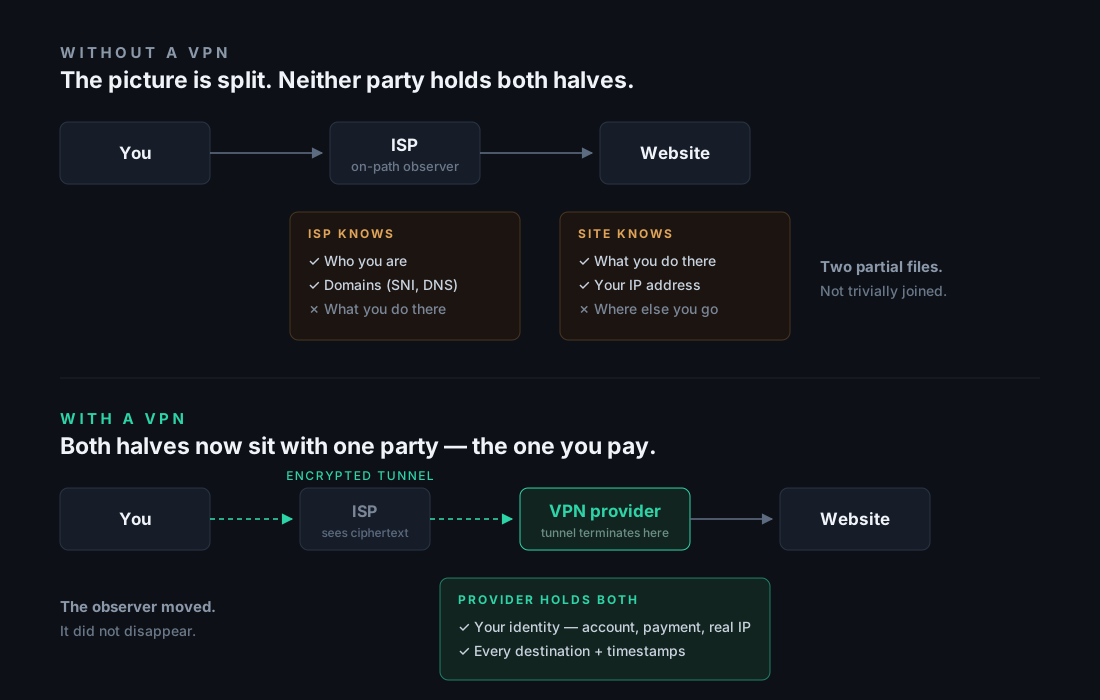
Without a VPN, the knowledge is split. Your ISP knows who you are — name on the account, home address, billing details — and which servers you reach. It doesn't know what you do once you're there. Each site you visit knows exactly what you did on it, but not who you are or where else you went. Neither party has the complete file, and neither can easily assemble it.
A VPN collapses that split. On one side, the provider holds your identity: the account, the email, the payment method, and your real IP at connection time. On the other side, it holds every destination you route through the tunnel. Same infrastructure, same timestamps, correlatable by construction.
This is the structural argument, and it holds regardless of any provider's intentions. You haven't eliminated a party with visibility into your traffic. You've created one with more visibility than your ISP ever had — and it's the one you're paying monthly.
Whether that party writes anything down is a policy decision you can't observe from the client side. Which brings us to the phrase doing the heaviest lifting in the entire industry.
"No logs" — a graduated claim, not a binary one
The lazy critique says no-logs claims can never be verified, so they're all worthless. The lazy defence says a privacy policy is proof. Both are wrong, and the truth in between is genuinely useful.
Start with the failures, because they're instructive.
In 2017 the FBI arrested a Massachusetts man for an extensive cyberstalking campaign. He had used PureVPN, whose policy at the time stated it kept no logs capable of identifying a user or monitoring their activity. PureVPN was nonetheless able to supply records showing the same accounts had been accessed from the same originating addresses — enough to correlate his home connection with the VPN sessions used in the campaign. No browsing history was required. Connection timestamps and source IPs were sufficient for a time-correlation attack.
HideMyAss had already been through a version of this years earlier, handing over connection records in a hacking case despite selling anonymous surfing.
In July 2020, researchers found an unsecured Elasticsearch cluster shared by seven Hong Kong–based VPN brands — UFO VPN among them — all advertising zero-logs policies. The exposure ran to roughly 1.2 TB across more than a billion records: account credentials in plaintext, email and home addresses, IP addresses, session tokens, connection logs and site-visit histories, affecting potentially 20 million users. Some of those users were connecting from countries where VPN use is itself illegal. The database was secured, then reappeared exposed at a second address days later.
Now the counter-examples, which matter just as much.
In April 2025 an Athens court dismissed charges against Yegor Sak, Windscribe's co-founder. A Windscribe server in Finland had been used to breach a Greek system; rather than going through the company, Greek authorities subpoenaed the Finnish data centre, found Sak's name on the billing record, and charged him personally. The case ran nearly two years and collapsed for lack of evidence — there were no logs to produce, so nothing tied him to the incident. Mullvad had earlier come through a Swedish police raid the same way: nothing on the machines to seize.
The pattern is not "everyone lies." The pattern is that verifiable signals exist, and they're distributed very unevenly:
- Independent audits with named scope. Deloitte for NordVPN, Securitum for Proton VPN across repeated cycles, Cure53 and Assured AB for Mullvad. What matters is whether the engagement examined server configuration and logging behaviour, or merely reviewed the legal text. Those are very different products sold under the same word.
- Diskless, RAM-only infrastructure. A reboot wipes state, which narrows the forensic window on any seized machine. Not a guarantee — a compromised running server still sees live traffic — but a real architectural constraint. Notably, Proton VPN argues publicly that RAM-only is not the decisive factor and prioritises audited policy and jurisdiction instead; that disagreement is worth reading rather than resolving by brand loyalty.
- Jurisdiction. Whether the provider sits inside a mandatory data-retention regime shapes what it can be compelled to start collecting.
- Tested under pressure. The strongest signal by a wide margin. A court record or a raid that produced nothing beats any audit, because it's the claim meeting an adversary rather than an accountant.
None of this gets you to certainty. It gets you to graduated, evidence-based trust — which is the only kind available for infrastructure you don't operate, and considerably better than a coin flip.
The honeypot problem
There's a category of risk here that follows directly from the structure rather than from any provider's misconduct.
A VPN service aggregates the traffic of people who specifically want that traffic concealed. Ordinary users stay with their ISP. The privacy-conscious ones cluster at a relatively small number of providers, along with their names, emails and payment details. That's a high-value dataset by definition — to advertisers, brokers, intelligence services and criminals alike.
In security terms, a system that presents as an ordinary target while existing to observe whoever enters is a honeypot. A VPN can become one three ways: it can be operated or acquired by the parties you're hiding from; it can be legally compelled to surrender what it observes; or it can be built badly enough that outsiders read along uninvited. In all three cases the service keeps working perfectly. The tunnel connects, pages load, the subscription renews. Indistinguishable from the inside — which is the entire design goal of a honeypot.
This isn't hypothetical. Facebook operated Onavo for years as a free VPN marketed on privacy grounds while using it to observe which apps its users ran and how. The product worked as advertised at the transport layer and functioned as surveillance at the business layer, simultaneously.
What a VPN does nothing about
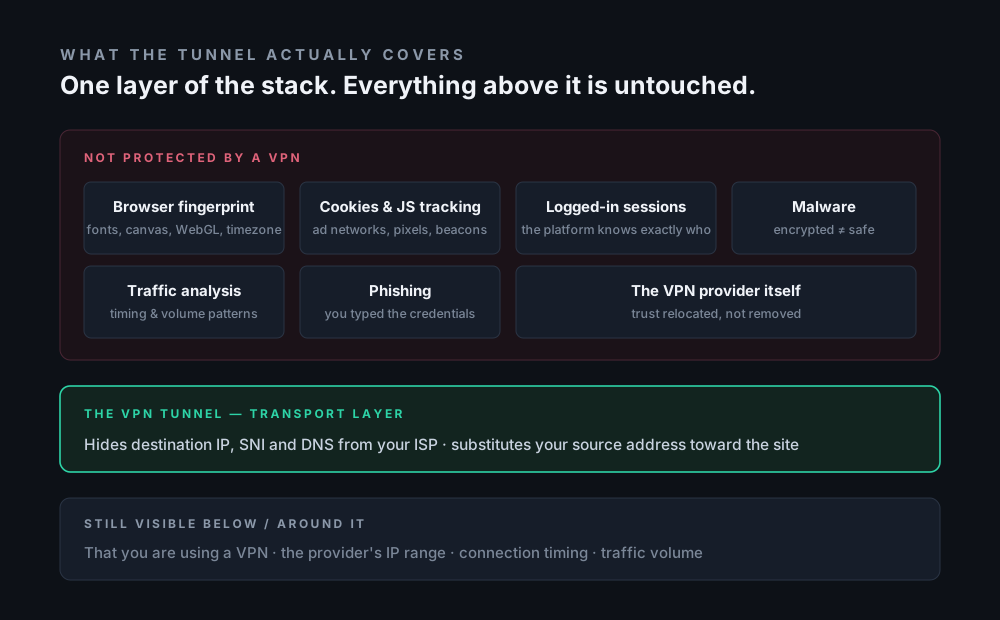
Even with a provider you've genuinely vetted, the tunnel terminates at the transport layer. Everything above it is untouched:
Browser fingerprinting. Your browser advertises fonts, screen geometry, language, timezone, canvas and WebGL rendering characteristics, extension side-effects and more. The EFF's Cover Your Tracks project measures how many bits of identifying information that combination carries — and a sufficiently distinctive combination identifies your browser across sites without any cookie, and without regard to which IP you appear from. Run the test with the tunnel up and down. The score barely moves.
Cookies and application-layer tracking. Encapsulation doesn't block JavaScript. That's uBlock Origin, container isolation, and strict tracking protection territory.
Authenticated sessions. The moment you log into an account, IP-level pseudonymity is irrelevant to that platform. It knows precisely who you are; the connection's origin is a footnote.
Traffic analysis. Packet timing and volume patterns survive encryption. This is a real and academically demonstrated class of attack, not a theoretical footnote, though it requires a capable adversary.
The correct mental model is not anonymity. It's pseudonymity at the transport layer, against specific observers. That framing tells you immediately which threats it addresses and which it doesn't.
Where a VPN genuinely earns its place
The technology was built for a concrete job it still does well: reaching a private network from outside it. A corporate VPN putting a remote employee onto an internal network is the original use case, and it works exactly as designed.
Beyond that:
- Censorship circumvention. Where a state blocks sites or services, a tunnel out is a legitimate route — as long as the VPN itself isn't detected and blocked, which is an ongoing arms race.
- Geo-restrictions. Reaching a streaming catalogue from another region works until the platform recognises the server's address range.
- Hostile local networks. Not for the reason usually advertised. With HTTPS near-universal, plaintext interception on café Wi-Fi is a far weaker threat than it was a decade ago. What a tunnel still protects on an untrusted network is SNI and DNS visibility, plus resistance to a malicious access point attempting interception.
- Peer-to-peer games and applications. Where clients connect directly rather than through a dedicated server, the other party sees your real address in the traffic arriving at their machine. A tunnel prevents that, and it's a genuine problem for anyone with a public profile.
- Denying your ISP a saleable behavioural dataset. Legitimate, and worth stating plainly: it's a preference about who profits from your metadata, not a claim about anonymity.
Every item on that list is about access, or about choosing which party sees your traffic. None of them is anonymity, and the list is more honest for admitting it.
Using one properly
If you've decided a VPN fits your threat model, the implementation details matter more than the brand:
- Select on evidence, not stars. Published audits with stated scope, infrastructure design, jurisdiction, and above all any record of the claim surviving legal pressure. Court documents outrank review sites.
- Verify DNS actually goes through the tunnel. A DNS leak sends your lookups to your ISP's resolver while you believe you're tunnelled. Test it. Most decent clients handle DNS internally — confirm rather than assume.
- Enable DoH or DoT regardless, and check whether the sites you care about support ECH. These close leaks the tunnel doesn't address at every hop.
- Turn on the kill switch. Without it, a dropped tunnel silently fails open and your traffic continues in the clear.
- Harden the browser separately. Fingerprinting and cookie tracking are a completely different layer with completely different tools.
- Delete free VPN apps from your phone. Someone pays for that bandwidth. If it isn't you, the mechanism is your data, your bandwidth, or injected advertising — and the UFO VPN case is what that looks like when the server is left open.
- If you need actual anonymity, use the tool built for it. Tor, with an understanding of its own limitations, and deliberate separation of identities across contexts. A commercial VPN is the wrong instrument for that job.
The point
Digital sovereignty isn't about buying the one box that fixes everything. Every tool in the stack protects a specific layer against a specific adversary, and the only way to build something coherent is to know which is which. A VPN protects the transport layer against your ISP and against the destination site's view of your address. That's a real, useful, well-defined capability.
It is not invisibility, and any vendor telling you otherwise has told you something about themselves.
Have you tested your own fingerprint at coveryourtracks.eff.org, with and without your tunnel? Operator and Controller members — I'd like to hear what the delta looked like.
Member discussion